Greatest moments in aviation
From the first fragile hops off a sandy dune to the roar of engines breaking the sound barrier and rockets slipping the bonds of Earth, aviation history is packed with breakthroughs that changed how humanity moves through the sky and beyond. Each milestone represents daring engineers, fearless pilots, and moments where the impossible suddenly became routine. Which of these achievements truly soars above the rest? Cast your vote and help crown the greatest moment in aviation history.
What counts: Seeded with approximate figures where shown — the crowd's votes decide the order.
Wright Flyer at Kitty Hawk▲ Rising
120 feet, 12 seconds, and suddenly the impossible was possible: on December 17, 1903, Orville Wright piloted a rickety wood-and-fabric contraption off the dunes of Kill Devil Hills while Wilbur ran alongside. It wasn't graceful and it wasn't far, but it was the first sustained, controlled, powered flight by a heavier-than-air machine — the ignition point for everything that follows on this list. Every jetliner, every moon rocket, every miracle landing traces its lineage back to those two bicycle mechanics who refused to accept that man couldn't fly.'
Era: 1903
added by IJR
94Lindbergh crosses the Atlantic▲ Rising
On May 20-21, 1927, a 25-year-old airmail pilot climbed into the cramped, single-engine Spirit of St. Louis and flew 33.5 hours alone from New York to Paris, fighting sleep deprivation and fog with nothing but a compass and nerve. Charles Lindbergh's solo transatlantic crossing turned aviation from a barnstormer's curiosity into a global sensation overnight, sparking a boom in airline investment and public fascination with flight. It's the moment the world realized the ocean was no longer a barrier — just a really long runway.
Era: 1927
added by IJR
69First 747 flight▲ Rising
When the Boeing 747 lumbered off the runway on February 9, 1969, its sheer improbable bulk — a 231-foot fuselage, a hump-backed upper deck, nearly 200,000 pounds empty — seemed to defy the very idea of flight. Instead it redefined air travel entirely, democratizing long-haul flying by hauling hundreds of passengers at once and slashing the cost per seat, birthing the age of mass international tourism. The 'Queen of the Skies' didn't just fly people across oceans; it shrank the planet for the middle class.
Era: 1969
added by IJR
32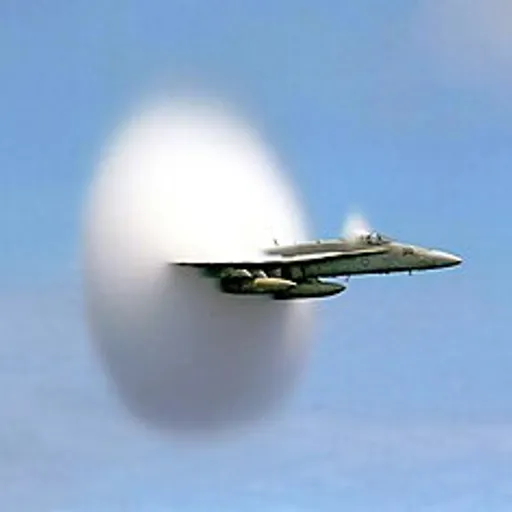
Breaking the sound barrier▲ Rising
On October 14, 1947, Chuck Yeager, flying the rocket-powered Bell X-1 with two broken ribs he hid from doctors, became the first human to exceed Mach 1, the sonic boom echoing across the Mojave as proof the 'sound barrier' was more myth than wall. It shattered the prevailing fear that supersonic flight would tear aircraft apart and opened the door to the entire era of jet fighters and, eventually, Concorde. Pure guts-and-slide-rule engineering, this is the moment aviation stopped being cautious and started being fast.
Era: 1947
added by IJR
17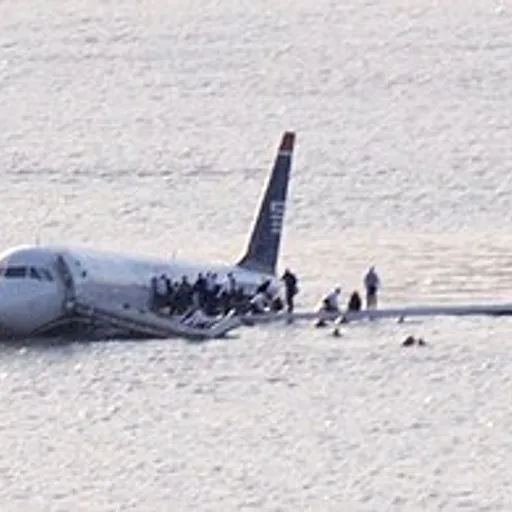
Miracle on the Hudson
On January 15, 2009, Captain Chesley 'Sully' Sullenberger lost both engines to a flock of geese over Manhattan and, with 208 seconds to decide, glided US Airways Flight 1549 to a controlled landing on the Hudson River, saving all 155 people aboard. No dramatic crash, no fireballs — just cold competence under absolute pressure, a masterclass in airmanship that became an instant symbol of skill triumphing over disaster. It belongs on this list precisely because it wasn't about pushing boundaries of speed or distance, but proving that human judgment can still out-fly catastrophe.
Era: 2009
added by IJR
4Voyager's nonstop world flight▼ Falling
In December 1986, Dick Rutan and Jeanna Yeager squeezed into the spindly, fuel-laden Voyager and flew around the entire globe — 26,366 miles — without stopping, without refueling, and without a single support flight, landing back at Edwards Air Force Base nine days later running on fumes. Built almost entirely of lightweight composites by Burt Rutan, the aircraft proved that endurance and efficiency could rewrite what unrefueled flight meant, decades before drones or solar planes chased the same dream. It's the ultimate underdog feat: two people, one fragile plane, and the whole Earth as the r
Era: 1986
added by IJR
-16Concorde service▼ Falling
From 1976 to 2003, Concorde screamed across the Atlantic at Mach 2.04, cruising above 50,000 feet and cutting a London-to-New York flight to under three and a half hours — breakfast in one city, lunch in the other, with champagne in between. It was commercial supersonic flight made real, a triumph of Anglo-French engineering that nothing since has matched or even attempted at scale. Its retirement, forced by economics and the Paris crash of 2000, still stings as proof that aviation's ambition occasionally outpaces its business case — but for 27 years, it was the fastest way humans ever travele
Era: 1976
added by IJR
-25First jet airliner▼ Falling
The de Havilland Comet took to the skies in 1949 and entered service in 1952, offering passengers a smooth, vibration-free ride at altitudes and speeds propeller planes couldn't touch — the true dawn of the jet age for commercial travel. Tragic metal-fatigue crashes grounded it within a couple of years, a brutal lesson that reshaped aviation safety and pressurized-fuselage design forever, but the concept it proved was unstoppable: jets were the future. Every 747, Concorde, and modern airliner owes its existence to the Comet's flawed, pioneering leap.
Era: 1952
added by IJR
-51
Keep ranking
Comments (7)
Free account · your comment posts right after signup
Exactly the kind of argument the internet was built for.
Voted — and the gap between #1 and #2 should be bigger.
- UUmar RossiJul 29, 2026
This order is closer to right than any editor would've gotten.
The crowd is sleeping on the bottom half of this list.