Most influential programming milestones
From the first compiler to the rise of AI-assisted coding, certain breakthroughs have fundamentally reshaped how humans instruct machines. These milestones didn't just advance technology—they redefined entire industries, economies, and the way we solve problems. Which moment do you think changed the course of programming history the most? Cast your vote and help settle the debate.
What counts: Seeded with approximate figures where shown — the crowd's votes decide the order.
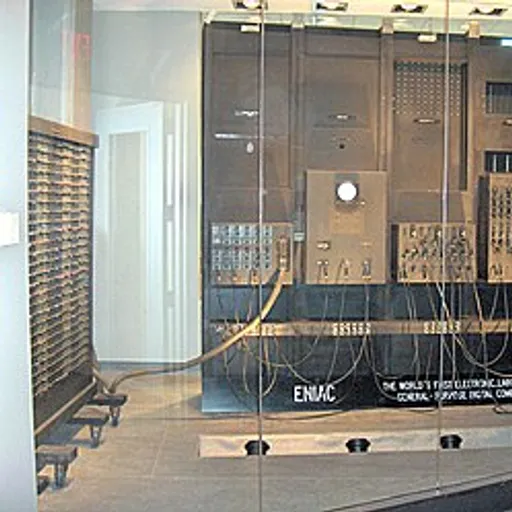
The ENIAC▲ Rising
Eighteen thousand vacuum tubes, thirty tons of hardware, and a room full of women physically rewiring plugboards to change programs — that was computing in 1945. ENIAC proved electronic general-purpose computation was possible at all, calculating artillery trajectories in seconds instead of hours, and every stored-program machine since owes it a debt for simply showing the door existed before anyone walked through it.
Era: 1945
added by IJR
91
The transistor▲ Rising
Bell Labs, 1947: a tiny sliver of germanium replaces a fragile, power-hungry vacuum tube, and suddenly computing has a path out of the basement. Without this switch shrinking relentlessly generation after generation, there's no Moore's Law, no microchip, no laptop in your bag — it's the physical bedrock every other entry on this list quietly stands on.
Era: 1947
added by IJRin 2 rankings
74The personal computer▲ Rising
The Altair on a garage workbench, then the Apple II and IBM PC on an actual desk — computing stopped being something institutions owned and became something a person could buy, program, and argue with at 2am. It's the moment the industry pivoted from mainframes serving corporations to machines serving individuals, seeding the entire culture of hobbyist hacking that followed.
Era: 1970s
added by IJR
57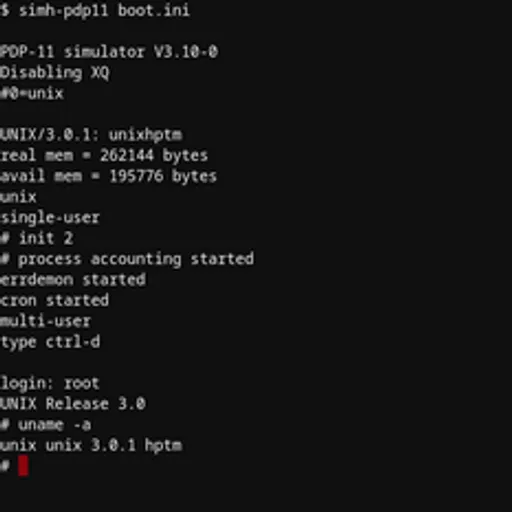
UNIX▲ Rising
Built almost as a rebellion — Ken Thompson and Dennis Ritchie hacking together an OS on a spare PDP-7 after Bell Labs pulled funding from Multics — UNIX gave the world pipes, 'everything is a file,' and the philosophy of small tools doing one thing well. Its DNA runs through Linux, macOS, Android, and iOS, making it the invisible skeleton of nearly every device you touch.
Era: 1969
added by IJR
37
The World Wide Web
Tim Berners-Lee at CERN in 1989, trying to solve the boring problem of physicists not sharing documents, ends up inventing hyperlinks, URLs, and HTTP — and gives it away for free. That single act of open-sourcing turned the internet from a plumbing network for researchers into the web everyone lives on, arguably the single biggest multiplier of what programming could even be used for.
Era: 1989
added by IJR
7
Linux▼ Falling
A Finnish student's 1991 Usenet post — 'just a hobby, won't be big and professional like gnu' — kicked off the largest collaborative software project in human history. Linux became the free kernel running the majority of servers, all of Android, supercomputers, and cloud infrastructure, proving that open, bazaar-style development could beat closed cathedrals at their own game.
Era: 1991
added by IJR
-16
The smartphone▼ Falling
The 2007 iPhone keynote fused phone, iPod, and internet communicator into glass and aluminum, then the App Store turned every pocket into a programmable platform overnight. It didn't just change hardware — it created an entirely new economy of mobile software and put a full computer in the hands of billions who'd never touched a desktop.
Era: 2007
added by IJR
-40The transformer paper▼ Falling
'Attention Is All You Need,' eight Google researchers, 2017 — a paper that ditched recurrence for self-attention and quietly detonated the current AI boom. Every large language model, from GPT to Gemini to the tool writing this sentence, traces its architecture back to this one dense, math-heavy PDF, making it the newest and most disruptive entry on the list.
Era: 2017
added by IJR
-48
Keep ranking
Comments (10)
Free account · your comment posts right after signup
The crowd is sleeping on the bottom half of this list.
Exactly the kind of argument the internet was built for.
Voted — and the gap between #1 and #2 should be bigger.
- BBianca JohnsonJul 27, 2026
This order is closer to right than any editor would've gotten.